
What Is the Cisco C9500 Built For? A Plain-English Guide to Campus Core Switching
Before you spend $10K+ on a switch, make sure you’re buying the right tool for the job. This guide explains where the Catalyst 9500 fits—and whether you actually need one.
The C9500 Is Not an Access Switch
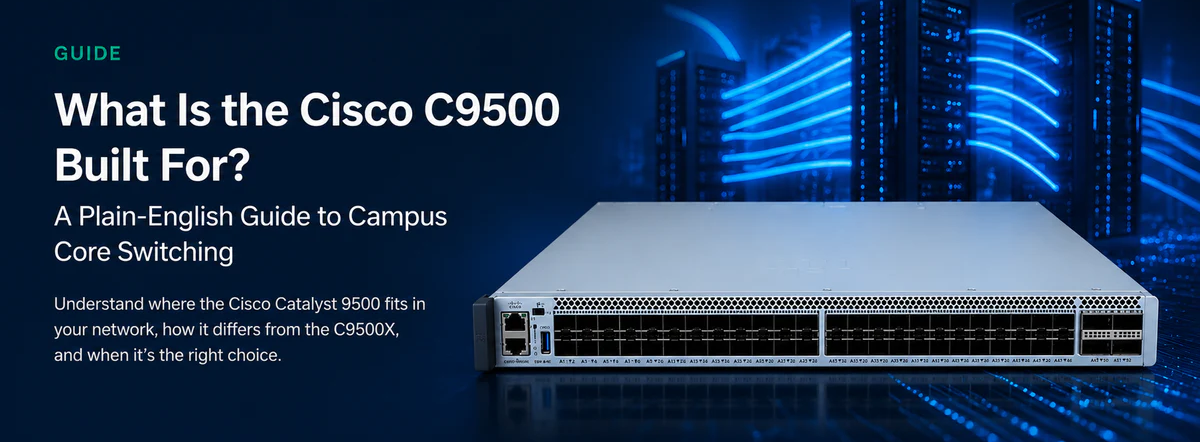
The Cisco Catalyst 9500 is Cisco’s fixed-form-factor platform designed for the campus core and aggregation layers. It handles the traffic that flows between buildings, data centers, and your WAN edge—not the traffic coming off individual desktops and phones.
If you’re evaluating enterprise-grade switches for a network refresh or greenfield deployment, the distinction matters. The C9500 is a fundamentally different tool than the Catalyst 9300, and buying the wrong one means overspending, under-delivering, or both.
Where the C9500 Fits in Your Network
Campus networks are built in layers, and each layer has a job:
- Access layer — This is where endpoints plug in: laptops, VoIP phones, wireless access points, printers, and IoT devices. The Cisco Catalyst 9300 family lives here, providing PoE, multi-gig speeds, and stacking for wiring-closet deployments.
- Distribution/Aggregation layer — This layer connects multiple access switches back to the core. It handles policy enforcement, inter-VLAN routing, and acts as the first point of traffic consolidation. The C9500 is purpose-built for this role.
- Core layer — The backbone. This is the high-speed fabric that moves traffic between buildings, campus segments, data centers, and the WAN. The C9500 is also designed to serve here, delivering the throughput and routing depth that core deployments demand.
The C9500 does not include PoE, which makes it a poor fit for access-layer use. What it does include is high-density 40G/100G/400G transceiver support, advanced routing protocols, and hardware-level redundancy features that access switches simply don’t need.
C9500 vs. C9500X: Two Sub-Families, Two Jobs
The Catalyst 9500 series actually consists of two distinct hardware platforms. Choosing between them comes down to whether you’re optimizing for features or raw performance.
C9500 (UADP 2.0 XL / 3.0 ASIC)
- Powered by UADP 2.0 XL or UADP 3.0 ASICs depending on the model
- Port options spanning 1G, 10G, 25G, 40G, and 100G
- StackWise Virtual for high availability—two physical switches operating as a single logical node with Non-Stop Forwarding (NSF)
- Full SD-Access, EVPN, and MPLS feature set
- Best fit: feature-rich campus core and aggregation where protocol support matters more than port density
C9500X (Silicon One Q200 ASIC)
- Up to 400G ports with 12.8 Tbps switching capacity
- Massive forwarding tables for MAC addresses, routes, ACLs, and MPLS labels
- Also supports StackWise Virtual for high availability, just like the standard C9500
- The first enterprise switch built on Cisco Silicon One—the same ASIC architecture used in service-provider routing platforms
- Best fit: performance-optimized core, large-scale environments, or campus-to-WAN gateway roles where throughput and table depth are the primary concern
Both platforms run IOS-XE and support the same management tooling. The difference is under the hood: UADP 2.0 XL/3.0 prioritizes feature breadth, while Silicon One prioritizes forwarding scale.
Key takeaway: If your campus core needs deep protocol support (SD-Access fabric borders, MPLS VPNs, NAT), start with the C9500. If your bottleneck is raw throughput, table capacity, or 400G uplink density, the C9500X is the right platform.
When You Actually Need a C9500
Not every network needs a dedicated core switch. Here are the decision triggers that point toward the C9500 family:
- You’re aggregating 10+ access switches and need 40G or 100G uplinks to keep pace with east-west traffic
- You’re deploying SD-Access fabric and need a border node or control plane node with full EVPN/VXLAN support
- You’re replacing aging Catalyst 6500 or 4500 series chassis and need a modern, fixed-form-factor equivalent with comparable routing and forwarding capability
- You need StackWise Virtual for hitless failover and Non-Stop Forwarding (NSF) without the complexity of a chassis-based platform
- Your WAN edge requires advanced routing—MPLS L2/L3 VPNs, multicast VPN, NAT—in a single platform that also aggregates campus traffic
- You need high-density, high-speed network modules for uplinks to data center or security appliance segments
When You Don’t Need One
Equally important: knowing when the C9500 is overkill can save your organization real money.
- If you need access-layer switching with PoE for wireless infrastructure, phones, and cameras, the Catalyst 9300 family is the right choice. The C9500 doesn’t support PoE at all.
- If you’re a small office with fewer than 10 switches, a well-specced C9300 can serve as a collapsed core—handling both access and core/aggregation duties in a single tier.
- If your uplink needs top out at 10G, the C9500 is overbuilt for your environment. A C9300X with 10G/25G uplink modules will deliver what you need at a lower price point.
- If budget is the primary constraint, make sure you’re not paying for 100G or 400G capacity you won’t use for years. Right-size your power supplies and networking hardware to current requirements with room for one generation of growth—not three.
Need Help Choosing the Right Platform?
Picking between the C9300, C9500, and C9500X doesn’t have to be guesswork. Our team works with organizations every day to match the right Catalyst platform to the deployment—at competitive prices with expert guidance.
Talk to an Expert